Incident command competence evidence
Prove your training compliance with AI roleplays.
Works against any framework. Criteria-by-criteria assessment. Custom roleplays for your worksites and organisation.
The AI runs the exercise and compiles the evidence. Your named assessor decides competence and signs off.
The evidence problems Maitris solves
Revalidation backlog
Commanders waiting on the right incident to evidence competence. Exercise it instead, and record it against the criteria.
Plan-test evidence
A regulation 15 test your inspector can read, repeated as often as you need.
Annual assurance return
Training and exercising evidence generated as a by-product of training, not assembled at year end.
How it works
Pick the framework. Run the roleplay. Get the compliance report.
- 1
Framework in.
Pick the framework you are assessed against. Roleplays for the well-known ones are ready to run, with every criterion already traced to its clause. Your own procedures can be layered on top.
- 2
Exercise generated.
Multi-agent scenarios play the roles around your commander: control room, crews, partner agencies, site staff. Conditions are set to meet awarding-organisation simulation rules.
- 3
Evidence out.
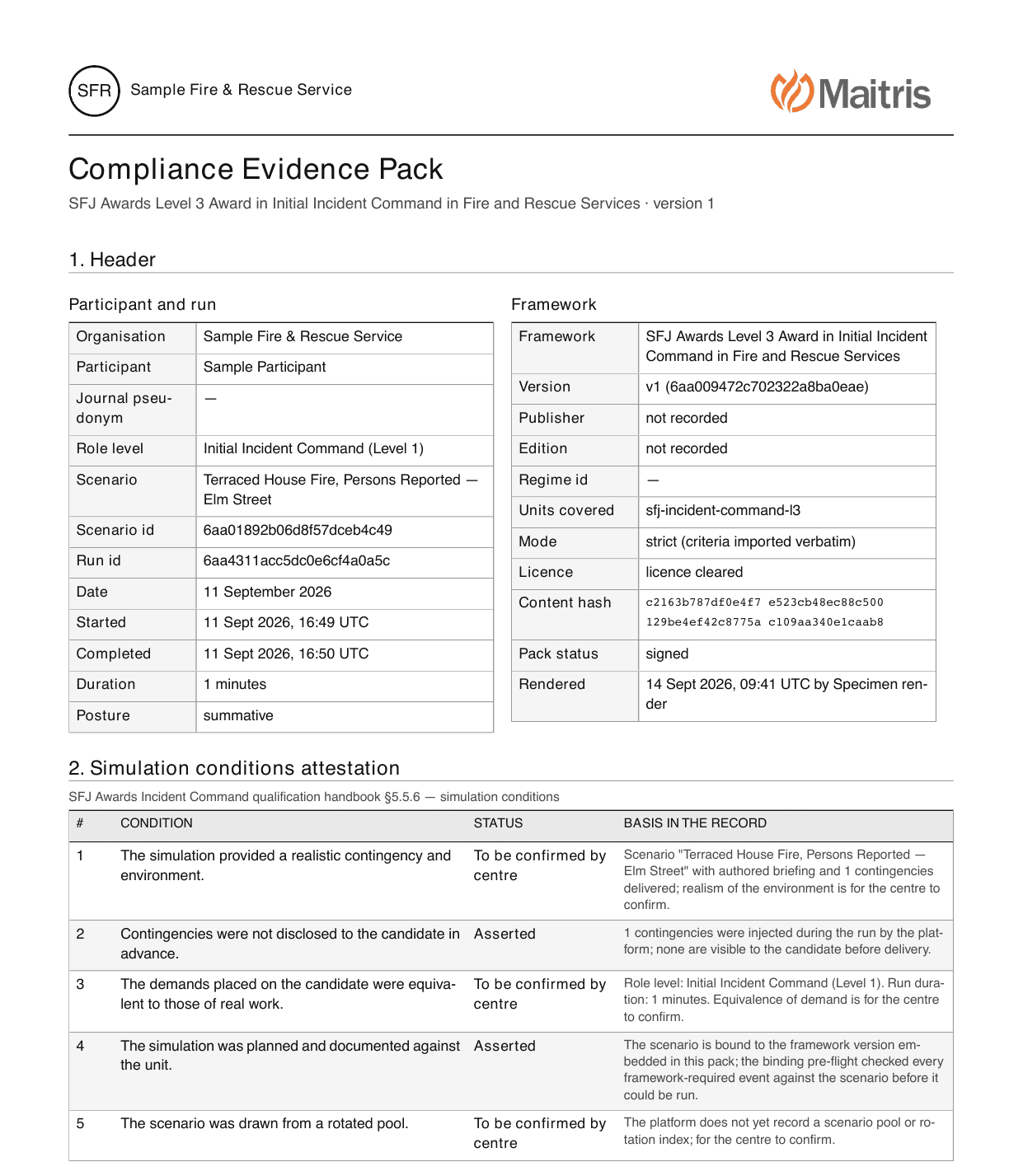
Each run produces a portfolio pack: criterion-by-criterion evidence, decision log, behavioural markers, assessor sign-off, exportable to your LMS.
Roleplays ready for the frameworks you are assessed against
Every framework below has roleplays and a compliance report built for it. Pick the one your assessor, inspector or board works from and run it.
Qualifications
UK statutory duties
UK regulator-enforced and assurance frameworks
EU and national law
International standards
Built for the evidence your sector is asked for
Same platform, different assessor. Pick your sector.
Revalidation evidence against SFJ Awards Levels 3–7 without waiting for the right incident.
Commanders waiting on the right incident to revalidate. HMICFRS asking for competence records. Inquiry recommendations asking you to show JESIP in practice.
Frameworks
Sample evidence line
Declared the tactical mode and confirmed it to Control and all sectors within four minutes of arrival. Decision log 00:03:52; radio transcript 00:04:10. Assessor: criterion met.
What the assessor receives
Every run produces a portfolio pack. The AI compiles it; the named assessor reviews it and signs off.
- Criterion-by-criterion evidence with the clause each one traces to
- Timed decision log and communications record
- Behavioural markers observed during the run
- Simulation conditions, for the assessor to judge against awarding-organisation rules
- Assessor sign-off and IQA sampling space
- Export to your LMS or portfolio system
Organisations we have trained










Questions assessors and training managers ask
- Will my awarding organisation accept this as evidence?
- Simulation is an accepted assessment method where workplace evidence is impractical or high-risk, which is the usual position for incident command. Each evidence pack records the simulation conditions so the assessor can judge whether they meet the awarding organisation's rules. The named assessor reviews the evidence and signs it off, and the internal quality assurer can sample runs in the same way as any other portfolio. Maitris does not certify competence and is not endorsed by any awarding organisation.
- Where does the AI stop?
- The AI generates the scenario, plays the roles around your commander and compiles the evidence against each criterion. It does not decide whether someone is competent. A named assessor reviews the evidence, adds their judgement and signs off. If the assessor disagrees with anything the AI recorded, the assessor's view stands.
- Which frameworks do you cover?
- Roleplays and compliance reports are ready to run for the frameworks in the library: UK statutory duties such as the Civil Contingencies Act, COMAH, NHS EPRR Core Standards and Martyn's Law; regulator-enforced frameworks such as JESIP and HMICFRS inspection; EU and US law; and the ISO 22300 series. Each entry shows the clause the training or exercising duty hangs on. See the framework library.
- Can we add our own procedures?
- Yes. Site emergency plans, standing orders and local procedures can be layered onto a framework roleplay, so the scenario reflects your site and the report still maps to the framework's criteria. Your document is interpreted into observable criteria, each traced to the section it came from.
- What does it cost?
- Individual subscriptions are listed on the pricing page. Organisations are priced by the number of commanders and frameworks, and the quickest way to get a figure is to book a walkthrough. See pricing.
- What is the compliance gap check?
- A free, three-minute questionnaire on how your organisation trains, exercises and records incident command competence. You get a score, a short report and a clear view of where the evidence gaps are. Take the compliance gap check.